Architects: Andersson-Wise, Austin, Texas
Laminator: National Glass
Tacoma, Washington’s spectacular Chihuly Bridge of Glass, which houses the largest public installations to date of Dale Chihuly’s glass sculptures, celebrates glass in more than one way. The Austin, Texas based Andersson-Wise Architects, also used glass to showcase and protect the magnificent collections, which are housed on a public pedestrian bridge open 24 hours a day. The Bridge spans a busy highway and links the Washington State History Museum with the city’s new Museum of Glass: International Center for Contemporary Art.
Since safety, security and modulation of light were critical to the design of the Chihuly Bridge of Glass, the architects sought various solutions to achieve their goals. After considering etched, tinted and sandblasted glazing options, the architects turned to the technical team at Solutia Inc, the world’s largest manufacturer of Saflex® protective interlayers for laminated glass. The interlayer is sandwiched between two pieces of glass, which are bonded together with heat and pressure to give glass impact resistance and other benefits.
More than 100 original artworks from Chihuly’s Venetian series are displayed on an 80-foot display section of the bridge. “Security was a high priority here,” says Arthur Andersson, principal with Andersson-Wise. The architects chose to protect each object with Solutia’s clear Saflex interlayer in a double laminate configuration. The 0.060″ thick laminate provided both security and safety, as this type of configuration is extremely difficult to penetrate with most hand tools. “If impacted by a vandal, the outer pane of glass might shatter but the interlayer would tend to remain intact and continue to protect the art until the glass panel could be replaced,” says Solutia’s technology manager Julia Schimmelpenningh. It also provides complete clarity for viewing of the art.
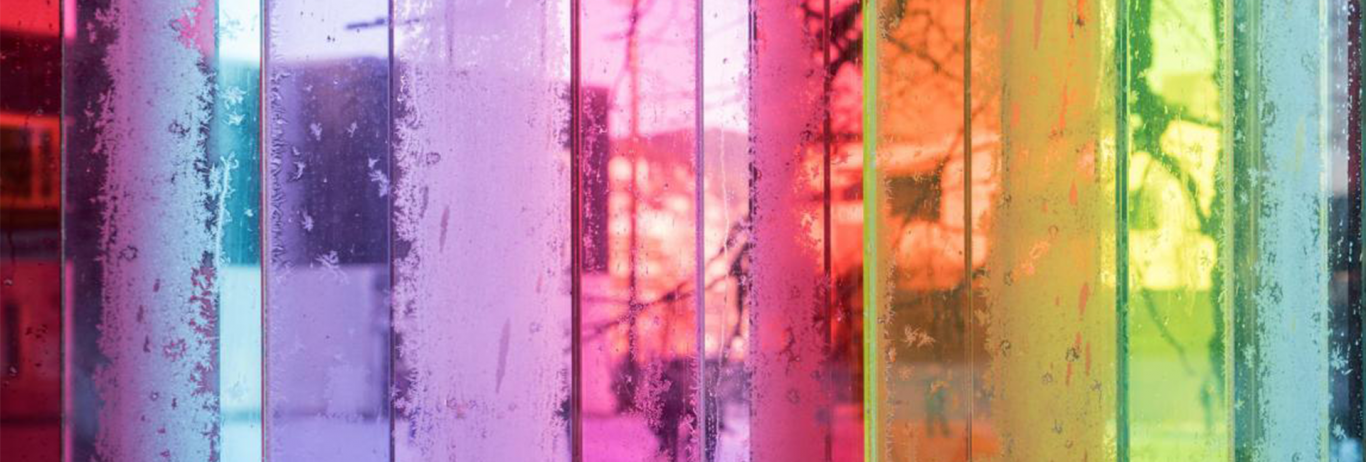
The glass used behind the Venetian Wall installations presented an additional design challenge. “We set out to provide a background for the art glass sculptures without making the glass panels completely opaque. We looked for a material that would allow for a subtle view of forms in the distance,” says Andersson. The architects experimented with a range of samples from Solutia’s new Vanceva™ Design Advanced Solutions for Glass™ interl ayers, which en able designers to incorporate a wide range of color and designs into glazing systems.
Andersson and his team selected a Cool White interlayer encapsulated between clear interlayers. “The effect is fantastic,” says Andersson. “The glass panels behind the art glass admit natural light. They also allow one to perceive silhouettes of buildings and moving cars down below the bridge without being a distraction to the Venetians.” The gl azing configur ation has already been tested, when a vandal shot a stray bullet from a distance during the first week the Bridge was open. The glass shattered, but continued to protect the art.
Chihuly’s Seaform Pavilion, which is adjacent to the Venetian Wall on the bridge, presented an entirely different challenge. The Seaform Pavilion is a ceiling made with thousands of glass sculptures from Chihuly’s Seaform and Persian series. Visitors view the ceiling installation by looking up through glass panels, on which the artwork rests. The panels were created with Solutia’s clear Saflex protective interlayers to provide both safety and security as well as meet code requirements for overhead glazing.
“The walls of the Seaform Pavilion, also made from glass, presented the greatest challenge,” says Andersson. “In order to emphasize the glass art above, we needed to limit most of the light coming from the sides at this pavilion.”
After much experimentation, the designers chose a Vanceva Design combination to create the darkened atmosphere needed for this section of the bridge. They created a custom environment by using a multi-ply laminate “sandwich,” which consisted of Evening Shadow colored interlayer sandwiched in between the Arctic Snow translucent interlayers. “This combination of interlayers creates a great enclosure for viewing the glass art, which is illuminated from above. From a distance, one perceives only a hint of pedestrians moving through the walls.”
“The most useful thing about using Solutia’s interlayers is the amazing flexibility they provide,” says Andersson. “By layering films of different tone and color one can easily create filters which modulate light according to specialized applications. We have not found other products that allow such a range of options.”