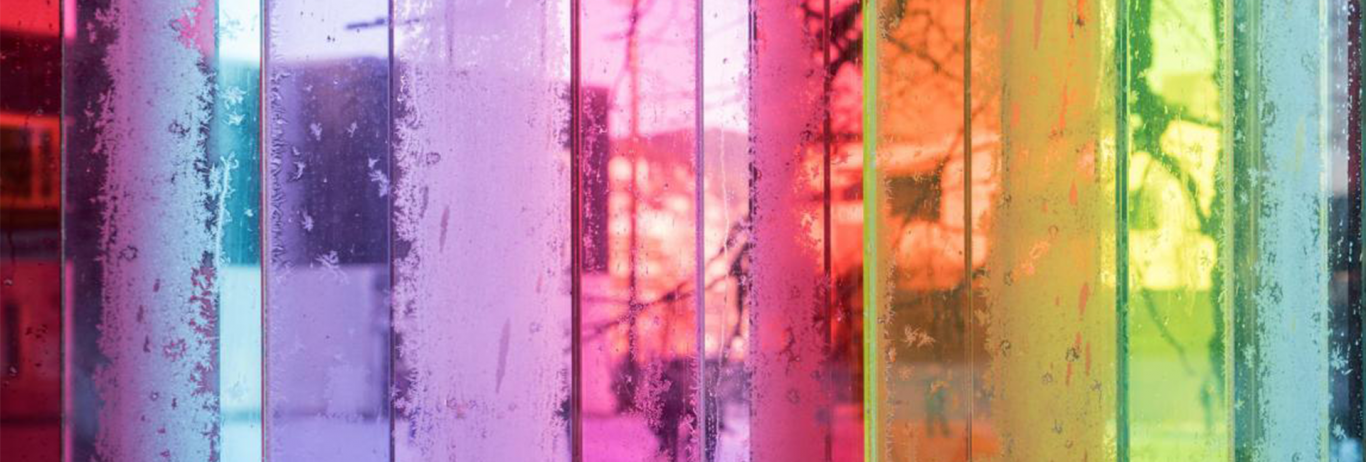
Aimee Davis, Architectural Market Manager of the Americas for Solutia Inc., explains how the Vanceva® Color System works.
Built to Inspire. Admired Around the World.


Architect: Nicolas Sack, Albonico Sack Mzumara
Glass Manufacturer: GSA
The intensity and luminosity of coloured glass has been used as a counterpoint to the crisp, ultra-modern, neo-urban style of one of the most upmarket property developments in Johannesburg, South Africa’s biggest city and most influenti al commercial centre.
Built in one of Johannesburg’s luxurious suburbs, Melrose Arch is among the country’s first mixed-use precincts – incorporating offices, retail stores, banks, medical facilities, penthouses, apartments, roof gardens, three award-winning restaurants, a luxury boutique hotel, and a three-storey Virgin Active gym.
A focus of interest for local and international corporate property investors, Melrose Arch operates as a city within a city.
It represents an emerging trend among South Africans to integrate the intimacy of their homes with the dynamism and diversity of high-street living in order to more readily access urban luxuries and give expression to an avante garde lifestyle.
Style and innovation rather than mere utility have been the basis for all the architectural and design briefs. Accordingly, architect Nicolas Sack of Albonico Sack Mzumara opted for two exterior lifts for the four-storey Melrose Arch Apartments. Faced with a challenge when he was unable to source brass cladding to shield the lifts from the sun, as specified in the original detail, he began to think in terms of glass, which could be installed in the existing aluminum framing system.
It was important that the glass would not crack under changes in day-night temperatures and would also provide some UV protection. In addition, if coloured glass were to be used, there had to be guarantees that the colours would not fade.
Sack designed the colours used on the lift shaft to follow the rainbow spectrum, passing from red at the top to violet at the bottom. Barry Holness, project manager for construction company Murray and Roberts, says that residents are delighted by the play of the colours on the lift shafts themselves and on the interior of the building. “Because the angle of the sun shifts during the day, every time you step into the lift you’re encased in different colours and therefore experience a different mood.”
By bringing a sense of the rich but clear quality of coloured glass into a high-tech environment, the Vanceva® interlaid glass used on the lift shafts has become a vibrant contributor to the panache and elegance of Melrose Arch as a precinct and to the emotional and intellectual stimulation of its residents.
January 26th, 2012
Hospitals are, by necessity, often large, utilitarian buildings. But that doesn’t mean they can’t also be cheerful, colorful, and kid-friendly. The All Children’s Hospital in St. Petersburg, Florida exemplifies this idea with a design that incorporates many glass windows in bright, fun colors. Project architect Ted Heldenbrand at Karlsberger perhaps summed it up best: “When we design hospitals, we design from the patient room out,” he says. “We wanted the patient rooms to be cheerful and colorful, and we extended that aesthetic into the glass windows.” For the children patients, the brightly colored windows inspire their imaginations and make the entire hospital experience less intimidating and more accessible.
Studies have shown that in hospitals, daylit interiors can help buoy patient morale and improve healing, so windows were a necessity in the All Children’s Hospital design. In Florida, however, glass needs to be able to provide hurricane protection as well as frame the views. Laminated glass provided a good solution because the PVB interlayers can stand up to damaging storms and also have the bright colors that inspire children to heal.
Project Category: Exterior
Project Name: All Children’s Hospital
Location: St. Petersburg, Florida
Glass Laminator/Supplier: Viracon, Inc.
Photographer Credit: Bann Tanner Photography – Michael L. Rixon
Karlsberger
Architect: Ted Heldenbrand
Address: 99 East Main Street, Columbus, OH 43215
Phone: 614-461-9500
January 25th, 2012
No longer reserved for paint and wall coverings, Architects and Designers continue to push the envelope, developing innovative color design methods for every glazing application. When exploring light, form, and space in the design process, glass can be the answer for all three considerations with the addition of Vanceva Color System by Saflex. Now airports, living rooms, and urban facades can showcase color in the glazing design.
“No other interlayer brand delivers the complete spectrum of colors for laminated glass like Vanceva Color System by Saflex,” said Julie Schimmelpenningh, global architectural applications manager for Saflex. “Used in curtain walls, atriums, skylights, partitions and conference rooms, Vanceva color interlayers allow the most expressive designs with distinctive hues from the subtle to the dramatic.” Producing a broad spectrum of colors and moods that are unachievable using stock selections of glass, Vanceva Color System by Saflex gives architects and designers more creative freedom with glass than ever before. Vanceva color interlayers can be combined to produce more than three thousand transparent, translucent or opaque color options to help create the desired tone and intensity. When Vanceva color interlayers are combined with tinted or reflective glass, the design possibilities are nearly limitless.
Order a sample set of the Global 2013 Vanceva® Color Forecast
January 24th, 2012
The playful colors and futuristic design of the Casa de Bonecas makes this modern dollhouse a favorite among children and their parents. Lilac, pink, and blue take center stage in this space, creating a modern, but entertaining atmosphere for children to play. While missing some of the more traditional aspects of a children’s playhouse, the Casa de Bonecas wholly embraces the distinctive “sized-down” features of a dollhouse. Included in the design are child-size furniture, an abundance of toys and books, and even a miniature Barbie® chandelier. Children love to play and imagine inside the vividly hued space and parents appreciate the high visibility allowed by the uninterrupted transparency of the glass.
To achieve this continuous view, architect Brunete Fraccaroli minimized the use of structural connectors, so that the laminated glass is supported only by a few beams. Fraccaroli explained her affinity for using glass in the design, saying, “We can use it to separate the environments without losing the interactivity…it is a lightweight material and has characteristics of modernity.”
In this play space, the laminated glass also provides health and environmental benefits. The use of glass reduces the need for electric lighting, so children receive a healthy amount of natural sunlight that they wouldn’t normally get playing in an indoor space. Also, the glass controls the absorbance of heat and UV rays into the building, rendering heating and air conditioning almost unnecessary.
Project Category: Exterior
Project Name: Casa de Bonecas
Location: Sao Paulo, Brazil
Glass Fabricator: Serie SunGuard Guardian
Photographer Credit: Romulo Fialdini
Architect: Brunete Fraccaroli
Brunete Fraccaroli Arquitetura e Interiores
Address: Rua Batataes, 460 – 4º andar – Jardim Paulista
São Paulo São Paulo 01423-010
Phone: 55 11 3885-8309
Architect: Carlos Ott, Uruguay
Builder: Coscan Construction
Glass Fabricator: Viracon
Glazing Contractor: Permasteelisa
The Miami skyline is home to a gleaming condominium tower, Jade Ocean. The tower, owned by Fortune Development and designed by world-renowned architect Carlos Ott of Uruguay, has become what is believed to be the first impact-resistant condominium curtainwall in the country.
Although Jade Ocean is loaded with innovative design elements, from multi-story waterfalls to sunrise and sunset infinity pools, glass is the real star of the project. In fact, after seeing Carlos Ott’s concept, the first step Fortune Development took was to select a curtainwall engineer and glass fabricator – even before choosing a general contractor. Permasteelisa North America, the world’s leading curtainwall manufacturer and Viracon, the country’s largest single-source glass fabricator, got the nod.
Due to an incredibly unique and colorful design, coupled with a need to meet Miami-Dade hurricane building codes, Fortune Development decided to make the glass and skin fabrication its top priority.
Ott’s design called for a 51-floor tower enveloped in a pure glass skin. Instead of a standard squared crown, Ott envisioned a radius curtainwall that arches back into the building. While most condominium towers consist of window wall systems, the design called for a pure, sparkling glass veneer. “The architectural elements of the façade would not have been captured as eloquently with a window wall system,” says Andrew Richards, owner’s representative at Fortune International, who was highly involved in the design and glass selection process. “The curtainwall design allows the building to be viewed as planes rather than only three dimensionally.”
“While curtain wall is often used in buildings such as offices and hotels, condominiums are usually window wall,” adds Maria Caleyo, project manager at Permasteelisa North America. “This is the first time we’ve worked on an impact condo curtainwall. Together with Viracon, we worked with the architectural team from the very beginning of the project to create the unique framing and glass system.”
Permasteelisa’s Miami team immediately set out to design the custom curtainwall system, which had to meet stringent hurricane code requirements and support durable impact resistant glass. While they focused on the frame, Viracon tackled the glass.
“With more than 300,000 square feet of external glass, selecting the right colors and coatings was critical,” says Jeff Rigot, Viracon’s architectural representative for Florida. “Not only did the glass need to create a very specific aesthetic, but it also needed to provide exceptional hurricane and energy performance and meet Florida Department of Environmental Protection (FDEP) Turtle Codes.”
Architects and owners wanted the building to evoke a subtle “sparkle” effect and wanted occupants to have a comfortable living experience. With Viracon’s help, the team ultimately opted to use two colors of glass to create distinct vertical lines on the façade, while providing owners with an energy efficient living environment.
“Viracon was extremely helpful and provided numerous samples for evaluation,” says Richards. “Without their full cooperation, we may not have been able to achieve the results we did.”
Gray glass with a low-e coating, Viracon’s VH13-50 product, was chosen for bands which primarily enclose living units. With a visible light transmittance of 50 percent, the glass allows ample natural daylight to flow into the living spaces without flooding them with excessive light. The Low-E glass also provides excellent radiant heat reduction, or shading coefficient characteristics, to help improve energy performance. The Low-E coating is ideal for living spaces, as it allows for two-way vision and lower reflectivity. The coating gives the glass a flat or natural look, which provides a beautiful contrast to the other glass used in the building.
The gray bands are alternated with a royal blue reflective glass, Viracon’s VT-40 product, to add shimmer and shine. This reflective coating gives the glass a mirror-like appearance and reduces solar heat gain through high solar reflection. The VT-40 product adds a shiny, crisp aesthetic to the building’s exterior but still allows 40 percent light transmission for comfortable interior spaces.
Although creating a custom impact curtainwall system for the entire building was quite an undertaking, designing the radius curtainwall crown was a feat in itself. “The team at Permasteelisa designed and engineered a phenomenal structural steel membrane to support the innovative arched top,” says Rigot. “The striking shape, combined with Viracon’s VS9-08 royal blue glass with a highly reflective coating
will brilliantly light up the sky.”
A Saflex PVB interlayer was incorporated into the glass throughout the curtainwall to meet impact requirements. The protective interlayer was also incorporated into the sliding door systems created and installed by Continental Glass Systems in Miami.
In order to closely monitor and control the quality of the finished product, the entire curtainwall was pre-glazed at Permasteelisa’s Miami facility and brought to the job site in large trucks.
Reaction to the building has been very positive. “Everyone is very happy with the finished product,” says Caleyo. With the dynamic mix of colors, coatings and design, Jade Ocean is true gem in Miami.
Courtesy of Denise Turner
In many parts of the world, interior designers and architects are required, by code to specify fluorescent lighting for commercial as well as residential interiors. However not all fluorescent lighting is created equal, which is why it is imperative that we specify the best possible light source; for the integrity of our designs and for the health of building occupants. LED lighting is rapidly emerging in every aspect of interior design and is gaining popularity for its color resolution and environmental benefits. Increased use of glass also meets the increasing demands of the environmental and energy issues that are tied to stricter building codes. The expanded use of glass for interior partitions, doors, wall cladding and more helps to transmit and reflect natural, full spectrum light in a given space, and can reduce the building’s energy load.
Respected light researcher, Dr. John Ott, conducted a study on the effects of full spectrum lighting on humans. One classroom used standard fluorescent lighting while the other used full spectrum lighting. The children exposed to standard fluorescent lighting displayed hyperactivity, fatigue, and difficulty concentrating. The students in the full spectrum lighting classroom had much better academic performances, were calm and developed one third fewer cavities than those children in the cool white fluorescent class room. Light therapy is also a common hospital procedure for treating premature, jaundice infants.
The Mayo Clinic treats a verity of conditions with light therapy. By exposing patients to the bright lights of the light therapy box (more intense than standard household lighting) it alters their body’s internal clock or circadian rhythms. It suppresses their body’s natural release of melatonin and causes a biochemical changes in the brain.
The Mayo Clinic uses light therapy to treat conditions like:
Hearing this, it is not hard to imagine how better, more natural lighting through the increased use of glass could also affect patient recovery times in hospitals and medical facilities around the world.
A bright rainbow of glass panels greets students, teachers, and visitors to the New Hampshire Institute of Art. The six-story addition was meant to respond to the various façades of the historic building and provide a backdrop for its strong, pitched roof. Utilizing sustainable technology, the design of the building merges high efficiency electrical lighting, a geothermal heating and cooling system, and natural lighting and ventilation with high design standards that embrace both the old and the new of the Institute.
Project Category: Exterior
Project Name: New Hampshire Institute of Art
Location: 88 Lowell Street, Manchester, NH
Glass Supplier: OldCastle Building Envelope™
Glazing Contractor: Granite State Glass
Photographer Credit: Michael Rixon
The Architects
Architect: Dennis Mires, P.A.
Address: 697 Union Street, Manchester, NH
Phone: (603) 625-4548
Black is the inclusion of all colors, unlike white which has no color. Black creates a sense of intrigue, depth and high drama. It is a color that some find magical and sexy and very masculine. For others it is too somber and uncomfortable. Used sparingly, however, it can be extremely elegant and can effectively highlight framed works of art and to set off other colors near it.