Twitter Feed
Follow Us on Twitter

Design Project Profile: The Funenpark

Share

Architect: Frits van Dongen, de Architekten Cie.
Designers: Christa Rinzema, Adriaan Mout, Dick Scholten and Alejandro Hernandez, Stephan Oehlers

Which city does not need to combat urban depopulation? City centres are gradually emptying, resulting in deserted streets and abandoned dwellings, with office buildings replacing homes, taking away any feeling of warmth.

Amsterdam wanted to reverse this trend and so, close to the narrow canals that are characteristic of the Dutch capital, rises the Funen. It’s not just an architectural project, it’s a hybrid concept – a combination of homes, workplaces and nature in the centre of Amsterdam. Frits van Dongen, a partner with the architects, Architekten Cie., has created an astonishing location.

Around a central park, various styles of houses and apartments are hidden away amongst the greenery, like “Secret Treasures”. The architect’s influences are numerous and varied. He has taken his inspiration from traditional closed urban blocks, more open developments including courtyard layouts, as well as from German “Siedlungen” and English “Garden Cities”. His imagination has created a countryside area right in the densely packed city centre of Amsterdam: an absolute delight for future residents!

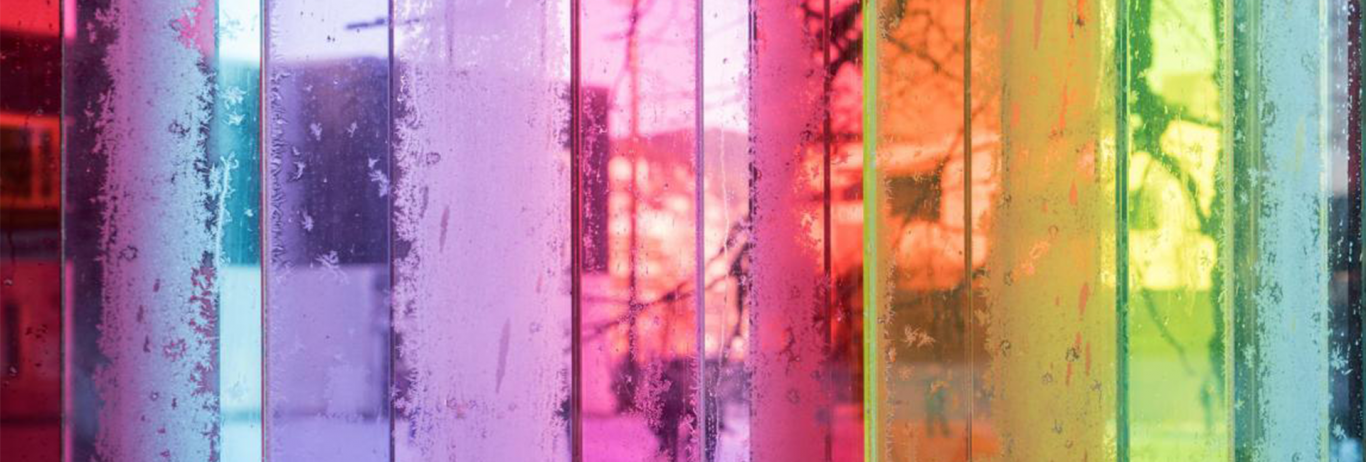
In order to protect this parkland residential area, Frits van Dongen has envisaged a block of apartments separating the Funen from the railway line, to the East of the site. And to dress its façade, the architect has used laminated glass with Vanceva® interlayers covering the whole length of the block. For a full 5000 m2, Vanceva® becomes the coloured shell of the Funen, as well as its most recognizable feature!  In fact, train passengers can read the word “Funenpark” on the facade. To achieve this effect, Vanceva® coloured films have been integrated into the short sections of the saw-tooth laminated glass, allowing the facade to constantly change its appearance thanks to the palette of shades, that can be seen from both the inside and outside of the building – colouring the 5000 m2 surface yellow, green, pink, blue and orange. The East facing facade is bathed in light when the Sun is in the South, reaching right into the building – delighting and astonishing train passengers on every journey!

Vanceva® has become the building’s second skin and its distinguishing feature to the outside world.

The Vanceva® interlayers also provide soundproofing, since the railway line is very busy and therefore noisy. The laminated glass incorporating Vanceva® films is more effective in reducing noise than all conventional glazing systems and limits the surge effects of frequency ranges of between 1000 and 2000 Hertz. The sound-proofing properties of laminated glass thereby reduce the nuisance caused by nearby rail traffic.

The Funen is a complex comprising 312 homes, a business area (offices) of 3000 m2, an underground car-park with 235 spaces, as well as shops and restaurants.  It’s a complete way of “urban” life which is gradually being recreated on this former industrial site.

The Funen is a truly groundbreaking project, a new concept in town planning, which encourages residents not to leave the city but to come back and live here without losing all the benefits of other devolved districts. While many other cities are suffering from depopulation, Amsterdam is winning the battle to repopulate its city centre.

Design Project Profile: Knutpunkten

Share

Architect: Wingårdh Arkitektkontor AB
Glazing Manufacturer: Gemax Glas AB

Knutpunkten in Mölndal is, next to the Nils Ericsson-terminal in Gothenburg, the most important bus and railway station in the region.

The process of renewing the station and turning it in to an attractive part of the city begun with a competition for architects in year 2000. The winning entry from Wingårdh Arkitektkontor AB, used laminated glass with Vanceva® interlayers to give the station building its characteristic and vibrant look that catches peoples eyes. The building’s design resembles the terminals you see in today’s modern airports.

The laminated glass especially comes to its right during nighttime, when the glass is illuminated from the inside and makes the building a beautiful, glowing experience.

Furthermore, the building has a shape and structure that makes it appear as if it was floating above the tracks and connects two parts of the community, which are divided by one of the main highways of Gothenburg. The unique shape in combination with the laminated glass in many colours has made the building a central and important part of Mölndal.

The architects at Wingårdh Arkitektkontor AB wanted to create a positive and cheerful attitude that would become an eye catching experience, and to do this they used the laminated glass with Vanceva® interlayers. They also chose the laminated glass for the building because of its ability to withstand weather and sound.

Bengt Odlöw, local government commissioner, Mölndal, has expressed his positive and proud feelings on the project stating, “Knutpunkten has become a welcoming and positive passing place both for the city’s inhabitants and for travelers passing by. Today it is a natural centre for public transport and a beautiful asset to Mölndal’s inhabitants”.

The new bus and railway station not only connects the public transport in an effective way, but also contributes to a more beautiful townscape.  The accessibility to the central parts of Mölndal has also increased considerably through Knutpunkten.

Lofts in Color

Share

Architects: Rearquitectura / Antonio Menéndez Ferrer – Cristian Barrientos Vera
Location: Cerro Yungay, Valparaiso, Chile

Lofts Yungay II is a collective housing building located in the outskirts of the World Heritage Area of Valparaíso, Chile. This city is one of the largest Chilean ports in the Pacific Ocean. Valparaiso’s landscape is very characteristic due to its many hills packed with colorful houses almost falling out of the cliffs.  Each house is different from one another, but together they create a harmonic landscape.

Read more

Color Definition #4

Share

BROWN – We think of our roots when we see brown. We also associate it with aging since most things turn a shade of brown over time. We get an earthy feeling from lighter shades, such as beige, tan and sand, while darker shades can feel a bit murky or foreboding. If you mix brown with shades of red, it will absorb glare. Therefore, it is an effective color to use in rooms with harsh light and where the climate is dry.

Restaurant Valvas’or – Valvas’or interier – © AKSL arhitekti d.o.o.

Source

theWit: Arresting Glass Accents Attract Visitors from All Over

Share

The unique glass façade of theWit immediately stands out to passerby thanks to the striking chartreuse accent that zigzags up the face of the building. The design both adds safety to the building and reflects the exciting aesthetic of theWit’s location in Chicago’s theater district. Reminiscent of flashing marquee lights, the bright zigzag accent has helped theWit to become a prominent location for tourists and locals alike to visit. Architect Jackie Koo says of the project, “I’m really pleased with the way it turned out, but I’m most pleased about how it has successfully become a member of the community. It’s not just a destination for tourists; it is a part of the Chicago street scene and has revitalized a formerly derelict corner of the Loop.”


Project Category: Exterior

Project Name: theWit

Location: Chicago, Illinois

Glass Laminator: Viracon

Glazier: Trainor Glass Company

Photographer Credit: James and Connor Steinkamp

Koo and Associates

Architect: Jackie Koo

Address: 53 W. Jackson Blvd., Suite 235, Chicago, IL 60604

Phone: 312-276-8459

The Vanceva Color System

Share

Aimee Davis, Architectural Market Manager of the Americas for Solutia Inc., explains how the Vanceva® Color System works.

Design Project Profile: Melrose Arch Apartments

Share

Architect: Nicolas Sack, Albonico Sack Mzumara
Glass Manufacturer: GSA

The intensity and luminosity of coloured glass has been used as a counterpoint to the crisp, ultra-modern, neo-urban style of one of the most upmarket property developments in Johannesburg, South Africa’s biggest city and most influenti al commercial centre.

Built in one of Johannesburg’s luxurious suburbs, Melrose Arch is among the country’s first mixed-use precincts – incorporating offices, retail stores, banks, medical facilities, penthouses, apartments, roof gardens, three award-winning restaurants, a luxury boutique hotel, and a three-storey Virgin Active gym.

A focus of interest for local and international corporate property investors, Melrose Arch operates as a city within a city.

It represents an emerging trend among South Africans to integrate the intimacy of their homes with the dynamism and diversity of high-street living in order to more readily access urban luxuries and give expression to an avante garde lifestyle.

Style and innovation rather than mere utility have been the basis for all the architectural and design briefs. Accordingly, architect Nicolas Sack of Albonico Sack Mzumara opted for two exterior lifts for the four-storey Melrose Arch Apartments. Faced with a challenge when he was unable to source brass cladding to shield the lifts from the sun, as specified in the original detail, he began to think in terms of glass, which could be installed in the existing aluminum framing system.

It was important that the glass would not crack under changes in day-night temperatures and would also provide some UV protection. In addition, if coloured glass were to be used, there had to be guarantees that the colours would not fade.

Sack designed the colours used on the lift shaft to follow the rainbow spectrum, passing from red at the top to violet at the bottom. Barry Holness, project manager for construction company Murray and Roberts, says that residents are delighted by the play of the colours on the lift shafts themselves and on the interior of the building.  “Because the angle of the sun shifts during the day, every time you step into the lift you’re encased in different colours and therefore experience a different mood.”

By bringing a sense of the rich but clear quality of coloured glass into a high-tech environment, the Vanceva® interlaid glass used on the lift shafts has become a vibrant contributor to the panache and elegance of Melrose Arch as a precinct and to the emotional and intellectual stimulation of its residents.

All Children’s Hospital: Colored Glass Windows Inspire Children Patients to Heal and Imagine

Share

Hospitals are, by necessity, often large, utilitarian buildings. But that doesn’t mean they can’t also be cheerful, colorful, and kid-friendly. The All Children’s Hospital in St. Petersburg, Florida exemplifies this idea with a design that incorporates many glass windows in bright, fun colors. Project architect Ted Heldenbrand at Karlsberger perhaps summed it up best: “When we design hospitals, we design from the patient room out,” he says. “We wanted the patient rooms to be cheerful and colorful, and we extended that aesthetic into the glass windows.” For the children patients, the brightly colored windows inspire their imaginations and make the entire hospital experience less intimidating and more accessible.

Studies have shown that in hospitals, daylit interiors can help buoy patient morale and improve healing, so windows were a necessity in the All Children’s Hospital design. In Florida, however, glass needs to be able to provide hurricane protection as well as frame the views. Laminated glass provided a good solution because the PVB interlayers can stand up to damaging storms and also have the bright colors that inspire children to heal.


Project Category: Exterior

Project Name: All Children’s Hospital

Location: St. Petersburg, Florida

Glass Laminator/Supplier: Viracon, Inc.

Photographer Credit: Bann Tanner Photography – Michael L. Rixon


Karlsberger

Architect: Ted Heldenbrand

Address: 99 East Main Street, Columbus, OH 43215

Phone: 614-461-9500

2013 Vanceva® Color Forecast: Collection Features 10 Refreshing Colors Suitable for Exterior and Interior Applications

Share

No longer reserved for paint and wall coverings, Architects and Designers continue to push the envelope, developing innovative color design methods for every glazing application. When exploring light, form, and space in the design process, glass can be the answer for all three considerations with the addition of Vanceva Color System by Saflex. Now airports, living rooms, and urban facades can showcase color in the glazing design.

“No other interlayer brand delivers the complete spectrum of colors for laminated glass like Vanceva Color System by Saflex,” said Julie Schimmelpenningh, global architectural applications manager for Saflex. “Used in curtain walls, atriums, skylights, partitions and conference rooms, Vanceva color interlayers allow the most expressive designs with distinctive hues from the subtle to the dramatic.” Producing a broad spectrum of colors and moods that are unachievable using stock selections of glass, Vanceva Color System by Saflex gives architects and designers more creative freedom with glass than ever before. Vanceva color interlayers can be combined to produce more than three thousand transparent, translucent or opaque color options to help create the desired tone and intensity. When Vanceva color interlayers are combined with tinted or reflective glass, the design possibilities are nearly limitless.

Order a sample set of the Global 2013 Vanceva® Color Forecast

Casa de Bonecas: Bright, Imaginative Use of Glass Creates a Fun, Interactive Children’s Space

Share

The playful colors and futuristic design of the Casa de Bonecas makes this modern dollhouse a favorite among children and their parents. Lilac, pink, and blue take center stage in this space, creating a modern, but entertaining atmosphere for children to play. While missing some of the more traditional aspects of a children’s playhouse, the Casa de Bonecas wholly embraces the distinctive “sized-down” features of a dollhouse. Included in the design are child-size furniture, an abundance of toys and books, and even a miniature Barbie® chandelier. Children love to play and imagine inside the vividly hued space and parents appreciate the high visibility allowed by the uninterrupted transparency of the glass.

To achieve this continuous view, architect Brunete Fraccaroli minimized the use of structural connectors, so that the laminated glass is supported only by a few beams. Fraccaroli explained her affinity for using glass in the design, saying, “We can use it to separate the environments without losing the interactivity…it is a lightweight material and has characteristics of modernity.”

In this play space, the laminated glass also provides health and environmental benefits. The use of glass reduces the need for electric lighting, so children receive a healthy amount of natural sunlight that they wouldn’t normally get playing in an indoor space. Also, the glass controls the absorbance of heat and UV rays into the building, rendering heating and air conditioning almost unnecessary.


Project Category: Exterior

Project Name: Casa de Bonecas

Location: Sao Paulo, Brazil

Glass Fabricator: Serie SunGuard Guardian

Photographer Credit: Romulo Fialdini


Architect: Brunete Fraccaroli

Brunete Fraccaroli Arquitetura e Interiores

Address: Rua Batataes, 460 – 4º andar – Jardim Paulista

São Paulo São Paulo 01423-010

Phone: 55 11 3885-8309

Twitter Twitter   Flickr   Flickr
Facebook   Facebook   YouTube   YouTube
RSS   RSS    
Solutia

© 2011 Solutia Inc. All rights reserved. SOLUTIA AND RADIANCE LOGO, Vanceva® and World of Color Awards are trademarks of Solutia Inc. As used herein, ® denotes registered trademark status in the U.S. only.

Privacy Policy

E-Newsletter

Sign up for our e-newsletter to get future World of Color Awards updates.