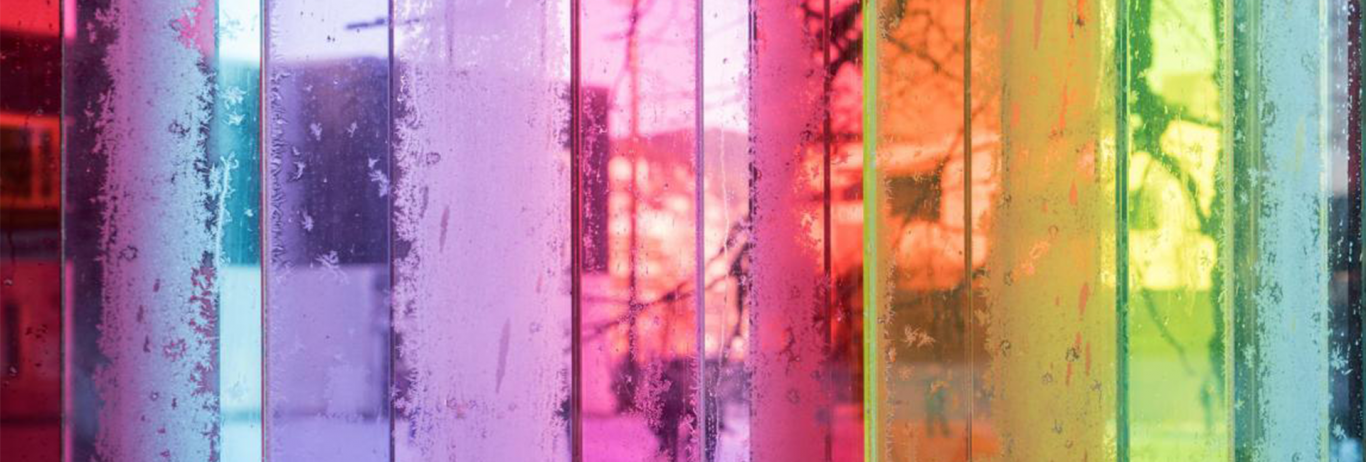
“Color and light must be entirely melted into one and felt as such – and light must be expressed as it is felt as color.”
~ Morgan Russell
Built to Inspire. Admired Around the World.


“The nice thing about colored interlayers is that they offer the colorful aesthetics combined with the performance benefits of laminated glass, including safety, security, solar and sound protection. They can even be used in combination with high-performance coatings and silk-screening to maximize performance and aesthetics.”
~ Alissa Schmidt

Solutia Inc. is proud to announce the winners of the inaugural World of Color Awards™ – Inspired by Vanceva®. For the past four months, designers around the world have been submitting the projects they believe demonstrate the most innovative and creative uses of colored glass, made with Vanceva®, in the built environment.
Courtesy of Julie Schimmelpenningh, Global Applic ations Manager at Solutia Inc.
Our world is enhanced and our interest is piqued everyday by the colors around us. The colors of the clothes we choose to wear, our cars, our homes and how we decorate our work areas all give some slight inkling into our personality and individualism. It’s the same for a faç ade or interi or gl ass of a building. “Some buildings are designed to blend harmoniously into the environment while others are meant to make a statement, stand out and be noticed.” Think of the elegant blue green buildings so prominently seen along coastlines, buildings meant to blend with the ocean, versus Circus Circus or New York New York in Las Vegas, Nevada, meant to draw attention.
The color choices for glass in a building can become very complicated if we let them. A basic understanding of color science is necessary to elevate our understanding and lead to inspiring selections of color that are endorsed by all members of the project team.
First we need to understand that colors are only seen by humans in the visible portion of the solar spectrum from about 380 – 400 nanometers (nm) through 700 – 780 nm, this varies with the reference consulted. The colors are “assigned” wavelength regions or “blocks” where they predominately seen, however there is considerable transition between those assigned blocks. For instance, green is noted to occur from approximately 480 – 560 nm with blue occurring below 480 nm and yellow occurring above 560 nm. However, at the upper limit of the “blue” region the color isn’t considered blue, but blue-green. At the bottom end of the yellow region, it’s not yellow, but greenish-yellow.
With so many transitional color possibilities, it is no wonder color choices can seem to be a huge task. Couple the number of possibilities with all the variables in perceiving color, no two people see things the same. Variables like light source, viewing angle, the viewer’s sensitivities, perceptions of certain colors, their age and even which sex they are all affect how color is perceived and defined. So how is someone supposed to see the color they like and want, and get that exact color specified and delivered?
There is no way to control all the variables, so pick a color that best states the objective of your project, ensure awareness of the variables throughout the value chain and don’t be wary to color often!
“The nice thing about colored interlayers is that they offer the colorful aesthetics combined with the performance benefits of laminated glass, including safety, security, solar and sound protection. They can even be used in combination with high-performance coatings and silk-screening to maximize performance and aesthetics.”
— Alissa Schmidt, Architectural Design Associate, Viracon Inc.
“I think the reason that there’s growth and excitement surrounding the use of colored laminated interlayers is the fact it unleashes the designer from the ‘same old’ glass substraight colors that have been around forever. Architects and designers now have the same pallet with glass that they have with paints- the whole spectrum! The world of possibilities open up and then you add the tremendous multi function properties of laminated glass, and you are really using a dynamic product option.”
— Max Perilstein, Vice President of Marketing, Arch Aluminum & Glass and Arch Deco